Home & belongings
How to label old family photos without losing their stories
A simple way to record names, uncertain dates and family stories, link notes to digital copies, and label photo enclosures without altering fragile originals.
Start with a small group and a separate record
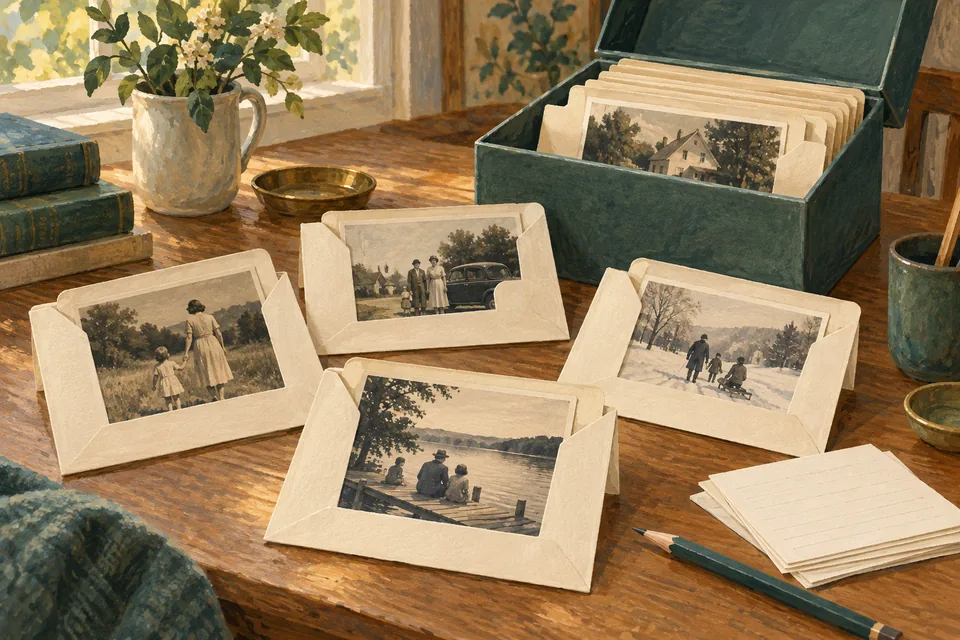
Give each photograph a simple reference number, write what you know in a separate record, and keep that number with its enclosure and digital copy. Record uncertain details as uncertain. You can preserve a useful story without identifying every face or writing directly on the original photograph.
Start with five photographs from one envelope or occasion. Keep their existing order while you work, especially if an album or a relative’s notes may explain how they belong together. This is a practical organizing exercise, not a requirement to catalogue every picture you own.
Choose a reference such as Family-001. In a notebook or plain text document, make an entry with the same reference. Avoid building a complicated code from dates or names that you may later correct. The reference is simply a way to keep the picture and its information connected.
For the first session, your goal is modest: five pictures whose notes can be found again. Finishing a small group is more useful than spreading a whole collection across the room and losing track of what came from where.
From our bookshelf: For the wider task of sorting family keepsakes, explore The Sentimental Downsizing Guide. The photo-labeling steps below are free to use.
Write the information a stranger would need
“Mum at the old house” makes sense to the person writing it. A future reader may not know whose mother or which house. Use full names where known, describe positions in a group, and give the place as specifically as the evidence allows.
- People: names, relationships and positions, such as “left to right.”
- Place and occasion: the town, house or event, if known.
- Date: an exact date, approximate period, or “unknown.”
- Source: who supplied the information, or which inscription supports it.
- Open question: one thing still worth asking.
An illustrative entry might read: “Family-001. Elsie Morgan, left, with her sister Joan. Possibly the garden of the King Street house, around 1965. Identification supplied by Ruth in October 2026; location not confirmed.” These names and details are fictional, but the distinction between knowledge and a guess is the useful part.
Copy existing writing accurately before trying to interpret it. If two relatives remember different places, record both accounts and who gave them. You do not need to choose a winner to make the record helpful.
Label the enclosure when the photograph is uncertain
The National Archives’ photograph-care guidance advises avoiding ink and markers around photographs. Light pencil identification is possible on some paper prints, but not every surface accepts it; captions can instead go on the enclosure. Its guidance also advises against repairing photographs with tape or glue and says to stop if handling is causing damage.
For an unfamiliar or fragile photograph, keep your notes separate and label an appropriate enclosure before placing the photograph inside. Do not experiment with pressure or different pens on the original just to make a reference number stay. If an item is stuck, brittle or deteriorating, seek advice from a photograph conservator before attempting treatment.
Put the matching reference at the top of your written record. Include where the original is kept, such as “photo box A, folder 2.” That location can change later; update the record when it does. Avoid sticky notes or labels attached directly to the photograph as a shortcut.
Give the digital copy a name you can find again
If you already have a digital copy, include the reference in its filename. For example, Family-001_garden_approx-1965.jpg is easier to connect to your notes than an unexplained camera filename. Use a similar name for a copy of the reverse when it contains writing, adding “back” so the two sides are distinguishable.
The Library of Congress recommends descriptive filenames, organized folders and descriptions for personal digital photographs. It also recommends keeping copies in different places and checking periodically that they remain readable. A single folder on one device is therefore a starting point, not a complete preservation plan.
Keep your written inventory with the copies, and make a brief note explaining your folder arrangement. Preserve an unchanged original digital file if you create a cropped or edited version. Give the edited version a different name so you can tell which is which.
There is no need to upload family pictures publicly to organize them. If you share a copy with relatives, include the caption and consider whether living people would be comfortable with wider sharing. Ask before turning a private identification conversation into a public post.
Ask one useful question, then finish the session
Send a relative one clearly identified picture with a focused question: “Do you recognize the person on the right?” or “Was this before or after the move?” A small request gives them somewhere to begin. An entire folder accompanied by “Tell me everything” may be harder to answer.
For today’s five-picture exercise, finish these steps: assign references, write the known details, mark uncertainties, connect any digital copies, and return the originals to their recorded locations. Note the next question and the person you could ask. Leave the next batch for another session if that is enough.
When the collection also brings up decisions about what to keep, try the free keepsake decision worksheet. Use it for one album or group of photographs: record its story, who owns it and what happens next. Labelling a picture does not oblige you to give it away.
Our guide to downsizing when family does not want your things explores that separate conversation. For further reading around making space while respecting what matters, explore The Sentimental Downsizing Guide.
Published by the books team. Examples are illustrative; practical exercises are editorial suggestions. Sources are linked beside factual claims. Editorial approach · Suggest a correction