
Home & belongings
How do I finally get the donation box out of my house?
Turn a stalled donation pile into one manageable handover: check what is accepted, choose transport and give the box a specific next step.
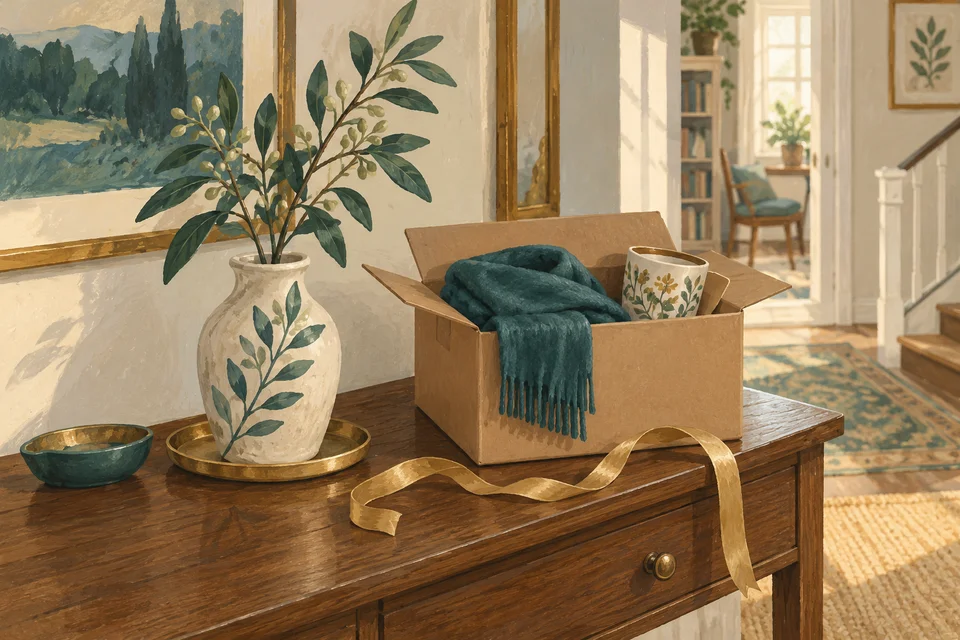
Give the box a destination and a next action
Choose one place that accepts the items, check its current instructions and arrange a realistic handover. Then put that action in your calendar. A donation box with a destination, transport and a time has a clearer finish than a pile you intend to deal with someday.
Start with a small batch. You do not need to finish sorting the whole house before taking one bag of suitable belongings away. If the box has been sitting by the door for weeks, ask what is actually missing: a decision about an item, a recipient, a lift, or an available hour. Those are different problems and need different next steps.
The suggestions below are an original planning exercise, not a rule about how quickly you should let things go. Keep anything whose ownership or future use is uncertain outside the donation batch until you have resolved that question.
Check the receiving place before packing more
Find the current donation page for a local charity, reuse centre or other organisation you want to support. Check the items it accepts, any condition requirements, opening hours and the correct drop-off point. If something is unclear, ask before making the trip. An organisation you used last year may have different arrangements now.
Goodwill’s donation guidance, for example, explains that accepted items vary by local organisation and recommends checking locally about furniture and pickup services. Use that as a reminder to verify your actual recipient, not as a promise that every branch accepts everything.
Keep unsuitable items out of the donation box. A broken object needing specialist handling is a separate task; consult the appropriate local disposal or recycling service. Avoid leaving a batch outside a closed centre unless its current instructions explicitly allow that method. A completed handover means the recipient has accepted the items.
Make the batch fit the transport you have
Perhaps the box is simply too large. Replace it with a bag or smaller container you can comfortably manage. Keep fragile objects protected and check the receiving organisation’s packing instructions. Do not make a heavy load your test of commitment to decluttering.
If you do not drive, consider a small batch you can carry on an existing journey, a lift someone has actually agreed to give, or a confirmed collection service. Availability, cost and booking requirements vary. Check those details before building your plan around a pickup. For larger belongings, ask how much assistance the service provides rather than assuming it includes moving items from anywhere in the home.
A fictional example: Maya has one bag of clothing and two boxes of kitchenware. She can carry the clothing on her usual bus trip, so that becomes the first handover. She leaves the kitchenware for a separate transport arrangement. Finishing one workable batch is useful progress.
Separate a real uncertainty from another round of sorting
A box can stall because one object is still undecided. Take that object out and write the question you need to answer: does it belong to someone else, is it part of a shared collection, or do you want to preserve its story first? The rest of the clearly chosen batch does not have to wait for that decision.
If an item matters because of a memory, the free keepsake worksheet gives you a place to record why. Our guide to sorting sentimental belongings explores that earlier decision in more detail. For gifts specifically, see the separate guide to gratitude and unwanted gifts.
You can change your mind before a handover. But if you have already decided, check whether reopening every bag is answering a new question or postponing the practical task. Try keeping one small, separate review container instead of returning everything to the cupboard.
Write a plan that includes the awkward part
“Donate this week” leaves several choices unfinished. Try a sentence with an actual occasion: “After my Saturday grocery trip, I will take this one bag to the centre whose opening hours I checked.” Include any earlier task that makes that possible, such as confirming a lift or finding a suitable container.
Use the free if–then plan builder if a prompt helps: “When I check tomorrow’s errands, I will confirm a donation stop.” Choose an action within your control. “When the charity calls, they will collect everything” is a hoped-for outcome, not an action you can arrange alone.
Add a practical fallback. If the centre is closed or declines an item, bring it back to a safe temporary place and check another legitimate option. Keep the box clear of exits and everyday walking routes. A missed trip calls for a revised arrangement, not a verdict on your character.
Try a five-minute handover card
Choose one already-sorted bag and write five lines: contents; intended recipient; acceptance and hours checked; transport; next action and time. Leave unknown details visibly marked. Your next task is to fill one of those gaps, rather than starting another cupboard.
For example: “Contents: clean scarves and two intact mugs. Recipient: local charity shop, acceptance to confirm. Transport: small bag on my usual walk. Next action: check its donation instructions on Thursday morning. Handover: choose a time after that check.” This is a fictional example to adapt; it does not describe any particular charity’s rules.
After the handover, remove that batch from your list. Notice the space it has freed without immediately assigning it to another pile. For the wider process of sorting belongings, preserving meaningful stories and talking with family as your home changes, explore The Sentimental Downsizing Guide.
Published by the books team. Examples are illustrative; practical exercises are editorial suggestions. Sources are linked beside factual claims. Editorial approach · Suggest a correction