Reading & creativity
How can I learn a new skill when I only have ten minutes?
Make a short learning session useful: choose one small task, try it, check the result and leave a clear starting point for next time.
Choose one thing you can actually try
If you only have ten minutes, choose one small part of a skill, make an attempt, check it against a trustworthy example and decide what to practise next. A short session can give you a useful beginning. It cannot promise fluency, expertise or a finished project on a deadline.
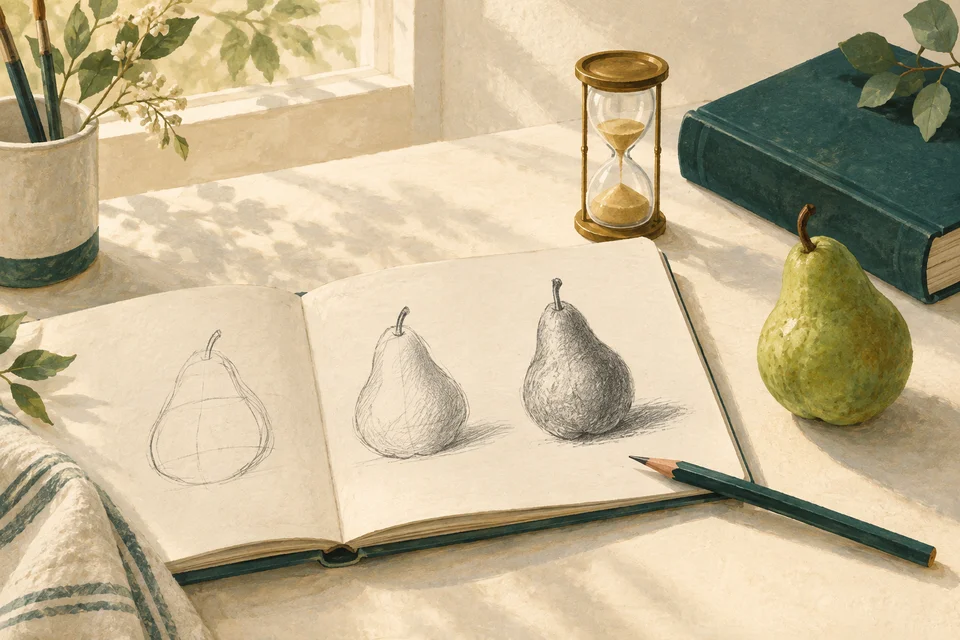
The important choice happens before you open another tutorial. “Learn to draw” is too large for this afternoon. “Draw the outline of this pear, then compare its width and height with the real object” gives you something you can do and inspect. You are choosing a practice task, not making a claim about how quickly you should improve.
For knowledge-based learning, Cornell’s Learning Strategies Center recommends retrieving information from memory and spreading study across separate sessions. Its guidance supports returning to material and checking what you understand. It does not establish ten minutes as a universal ideal for every skill. The schedule below is a practical starting point to adjust.
Give the session a visible finish
Pick a result you can look at when the time is up: one working spreadsheet formula, three sentences using a new phrase, a small sketch or an explanation of a concept in your own words. “Watch some videos” describes an activity, but it does not tell you what you will try afterwards.
Use this sentence: “At the end, I will have attempted ___ and checked ___.” For example: “I will have tried sorting a sample list and checked that each name still matches the right number.” Use invented data when practising software, so an experiment cannot damage an important file.
Choose a task appropriate for independent practice. Equipment, safety procedures and professional responsibilities may require instruction, supervision or a longer uninterrupted session. A short time slot is a constraint to plan around, not a reason to skip essential steps.
Try a two–five–two–one session
Here is an original ten-minute structure. Use an ordinary clock if you want; there is no need to buy a timer or treat the last second as a test.
- Two minutes: look at one example. Read a small section or watch a short demonstration. Identify the step you will attempt. Stop gathering alternatives for now.
- Five minutes: do the task. Make the sketch, write the sentences or solve one problem. Keep instructions nearby when the task calls for them. For something you are trying to remember, first attempt a brief explanation without looking.
- Two minutes: check. Compare your result with the example, answer key or stated goal. Name one difference that matters. Reopen the explanation rather than guessing that you were right.
- One minute: leave a restart note. Write what you tried, what needs attention and the first action for the next session.
If setup takes most of the time, make the next session smaller or prepare the materials beforehand. The proportions are suggestions. A useful correction matters more than obeying the clock.
Correct one thing before collecting another lesson
Imagine you are practising drawing a pear. Your first outline is narrow at the bottom. Instead of opening five new drawing videos, compare that shape with the object. Try a second outline with a wider base. Put the two attempts beside each other and note the change. You have a specific question for further instruction if it still looks wrong.
For a reading topic, the equivalent might be explaining one idea in three sentences, reopening the source and correcting a missing condition. Our guide to making notes you can revisit covers keeping a useful record. Here, the priority is the attempt and its correction rather than producing a beautiful page of notes.
When you cannot tell whether an answer is sound, mark it “needs checking.” Use a reliable worked example, a qualified teacher or an appropriate course. Confidence alone is not a checking method, and repeatedly practising an uncertain answer does not verify it.
Return to the same skill on another day
A collection of unrelated ten-minute introductions can be enjoyable. If your aim is to develop one skill, leave room to revisit it. At the next session, try yesterday’s small task again before adding another difficulty. Notice what you can now do without the same amount of help and where you still need a prompt.
You do not need a perfect daily streak. Choose a return point that fits your week, and reschedule if it disappears. The free if–then plan builder can hold a simple cue: “After Tuesday’s lunch, I will reopen my practice file and try the same formula with different sample numbers.” A fallback might be reading your restart note and selecting a new time.
Some tasks eventually need longer sessions, feedback or real-world practice. Let a short session reveal that need. Ten minutes can be a useful part of learning without having to become the whole plan.
Your next ten minutes
Try this small exercise on paper. Write four lines: the skill; one task; how you will check it; when you will return. Keep the task small enough that the checking step still fits. At the end, add one sentence beginning “Next time, start with…”
If you would like a ready-made practice task, visit the free elimination-table lesson in Curifold Puzzle School. Attempt its original puzzle before revealing the explanation, then compare the reasoning rather than simply ticking off the answer.
You are looking for evidence of learning: a clearer explanation, a corrected step or a question specific enough to ask. For broader introductory reflections on learning, creativity and everyday thinking, explore What Does Your Brain Need?.
Published by the books team. Examples are illustrative; practical exercises are editorial suggestions. Sources are linked beside factual claims. Editorial approach · Suggest a correction